Some Chapters From My Upcoming Work, 'Where Morning Never Comes'

Updated: Oct 1
The world of storytelling offers endless possibilities, but few stories linger in the mind like those that explore darkness and light in equal measure. My upcoming work, Where Morning Never Comes, dives into such a realm, weaving a narrative that challenges the boundaries between hope and despair, although shedding more light on the dark side, revealing the parts of history that are often left out.
The story revolves around Abigail Mason, a young girl on the third Roanoke Voyage (The one everyone knows, about the disappearance of the colony, in 1587). The book quickly offers a gripping glimpse into a world where hope feels distant and darkness lingers, especially for young Abigail, who is left with her aunt and uncle as food supplies dwindle, with little more than her doll as company, and a few troubled friends. At age 11, Abigail is the daughter of one of John White, head of the expedition’s top men, and provisions have run out, forcing him, her father, and Simon Fernandes, another captain, to return to England. Leaving behind some men in charge of the colony, along with Manteo, the historical native that befriended the English, the settlers run low on food and find they must voyage for help. Manteo takes some of the men to Croatoan, but they return with a hostile chief that wants the settlers to voyage to his lands on the other side of the sound. Soon, the colony finds themselves being held hostage, and Abigail befriends the chief’s daughter, in her plan to escape and return to the fort, for nothing more than to warn her father and the others of their fate when they return. But she must let go of her childhood and brave the trials of death, suffering, and betrayal, and outwit the forces that seek to control her, all to the backdrop of mother nature working magic in the pre-colonial new world.

With my conservation work, I spend a lot of time around timber rattlesnakes, which come in two general color morphs: gold and brown. After completing the novel, I realized, the spirits of Abigail and Tacumwah were these snakes, leading me along, safely, through the forest and this book.
Below are some chapters from this work, along with some illustrations, that lend sight into the themes, characters, and atmosphere that define this novel - particularly those after Abigail escapes the hostile group of natives, angered at the settler's ways, on her voyage back to Roanoke with her friend Tacumwah, the chief's daughter, and then a few more chapters that I added in, from the first 1/3 of the book, that give the other chapters some more background.

THIRTY TWO
THE SMALL RED bump on the top of her forehead, from where George hit Tacumwah with the stick, was caked with dry blood and she picked at it. Abigail pulled the long black braids of hair behind her head, to part it for Tacumwah to rub more of the ragweed on her scalp. A poultice of healing herbs and plants Tacumwah tore out in small handfuls from the bramble about them. It smelled of sage and basil leaf.
The girls sat together in the field and the early morning dew drops on the reed edges collected sunlight and scattered the glare in a thousand places and the birds sang a chorus echoing in the tree boughs, with the unseen autumn peepers balancing the harmony at ground level. The sunlight baked Abigail’s hair and she sat with her legs folded and Tacumwah spun around to face her, helping her remove briars from her dress.
Abigail found blood on her dress, and checked her hands, to see more blood than the stains on Tacumwah’s head. She felt a strong urge to spring up and run into the woods, like she might be dying, as her hand pulled her dress back, finding more blood on her legs.
She put a hand inside her chemise and she removed two fingers, and they dripped with fresh, dark black blood. She darted upward and Tacumwah grabbed her by the arm and pulled her back. Abigail thought about the blood, and it wasn’t the right time for it to happen. Why did it have to happen to her now, she thought. Out of all times for it to happen.
Tears rolled along her cheeks and Tacumwah held her arms and shook her to get her full attention. “Mawass'nen,” she said. “Kije manito,” she added. Tacumwah touched her fingers to Abigail’s and took the blood on her and reached toward Abigail’s cheeks. Abigail pulled away. They met eyes. Tacumwah kept her fingers raised with the blood on them and she looked inside her, searching over the little settler girl’s face, like she was seeking something material inside of her brain. A point to steady, then reach in to fix. Abigail’s two light blue eyes swam with fear and sadness.
“Mawjaatch keshawehk,” Tacumwah said. And she took the blood on her fingers and wiped a run of it under each one of the dark brown eyes on her native face, two war stripes of Abigail’s blood on her.
And then she stood up with her bow in hand and faced the sun with her eyes closed to bask in the light with the blood on her.

THIRTY ONE
SHE AWOKE TO the muffled, moaning, grunting, squirming girl in the darkness.
The air was cold and her body was near rigid, her fingers felt like sticks attached to her hands. She rolled in mud and a light rain in the night left her in slick patches of dirt that made rising difficult, until she had her dress under her knees to catch the ground and hoist herself with a firm grip on a clump of fescue. The fine moonlight helped illuminate the moaning, grunting bodies as she approached the two of them on the ground.
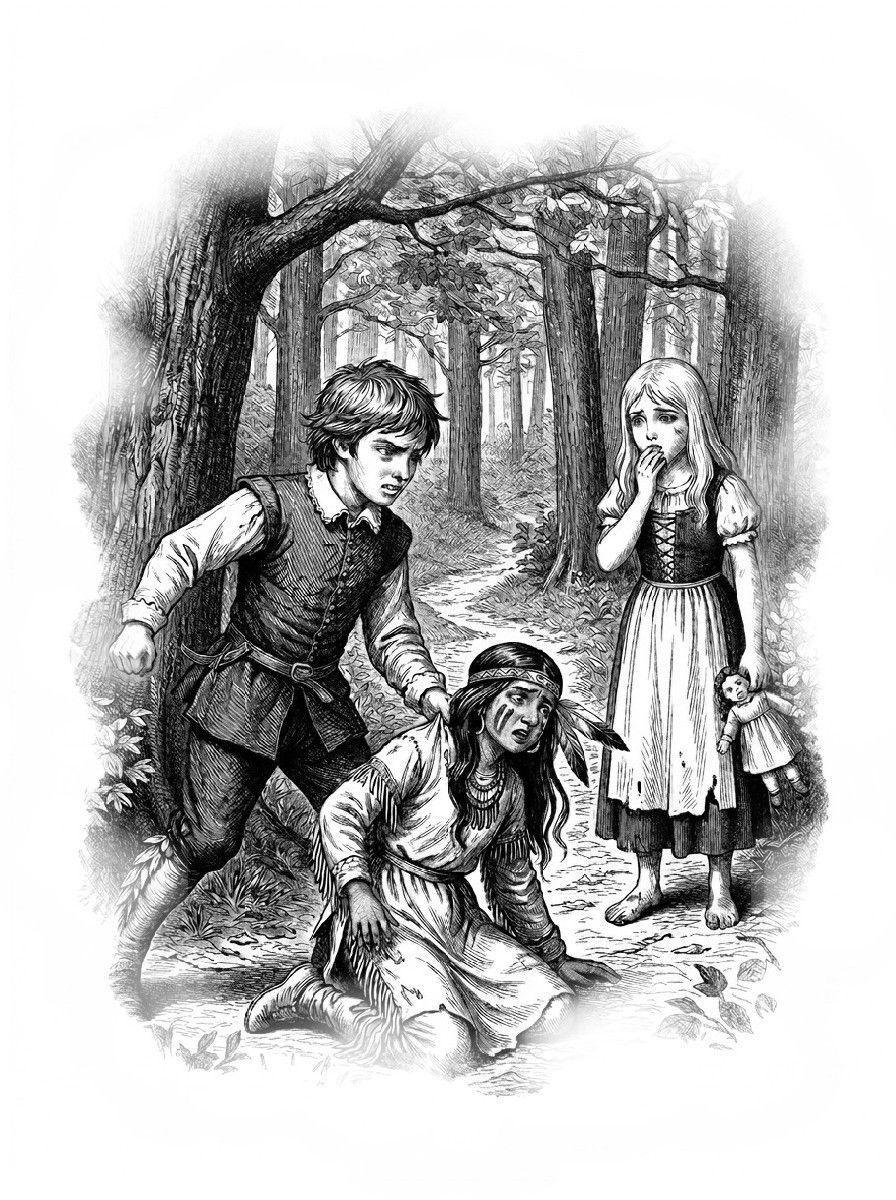
George Warren straddled Tacumwah and she was bound in rope and squirming. He had his pants down around his knees and the back of his ruff covered his naked bottom and his red suspenders flapped about, as he gripped her with his legs and kept her quiet with his hands around the binding rope he must have tied around her mouth as a crude gag. Abigail crept closer and rubbed her eyes to get a better picture of him raping her. Their forms were clearer and the clouds parted for more light to show them there.
A small broken branch sat beside him and she knew he must have knocked her out with it to tie the ropes and she could only obey what she felt must be done.
She went for the stick with a horror of intense fear and sickness. She wanted to spew her guts, and the more she watched him raping the native girl, grunting softly, the smell of brandy on him, the more she wished all people on earth were dead.
The stick felt light above her head and she raised it higher and she dropped it with a firm whack, and she knew she hit him hard enough when he grunted and slumped over with his chin tipped downward. He sat on the girl, still on top of her, slouched over in a prayer position.
She pushed him with the stick and he fell over on the ground, belly up. Tacumwah was squirming and Abigail dropped on her knees to help free her of the ropes tied around her hands. The native girl rose and pulled the gag from her soiled mouth and crawled to her feet.
“Kokosh,” Tacumwah yelled at George, lying on the ground. She spit at him. “Kokosh,” she said to him. She stormed off to grab her bow and a small pouch she slung over her shoulder and she made her way into the bushes.
Abigail stooped to check on George. He was still breathing, but he was unconscious. “Wait,” she said and she followed the small girl into the growing darkness with the light of stars illuminating her outline and tree leaves concealing her path away from the sleeping boy.
IN MOONLIGHT MEANDERING through gnarled branches and in open spaces around the shapes of small rock ledges in the nighttime woods they felt their way into the cover of forest and in the silence. They arrived into a small streaming brook that boiled over and the cascades filled the cold air with sounds of water moving from one stagnant vernal pool to something churning and containing life.
They moved without saying a word and the unspoken kept Abigail trusting her more, she thought, than if they might be speaking about the many things that didn’t matter at all anymore.
Abigail followed the reflection of the moon, like a pearl, far off from her focus, glowing in the shallow pools where the water quieted, in cascading steps, and her chafed bare feet fell firm on the bedrock, as she dodged the water and kept nimble on her toes. They dropped into a wet carpet meadow and then they followed dry grass up an embankment and found comfort in some tall beach grass weeds, bedding down to sleep together for the night. They kept cuddled with their backs turned to stay warm and Abigail clutched onto Audry and dreamed about being back at the fort, keeping her mind fixed on changing her clothing. It was all she could think of and what she desired most.
She slept and awoke, and she slept again, in bursts of bright blue starlight that shrunk time and hours felt like mere blinks of her eyes. The funnels of blue plasma were like paths of eyes for her to find in her dreams and the eyes took her into many situations of things that came, things to come, and things that might be happening all around her, things arranged and close to happening, but might never come in the morning.
In early daylight hours she awoke to a deer grazing beside them. The fawn was young and still with spots and snorting around in the grass, not more than ten paces from her naked feet.
She kept an eye open and she tipped her head and turned to find Tacumwah still asleep, or she thought so, but she couldn’t see the girl’s face, turned around. The deer chewed on grass and sniffed around and then lifted its head and shifted around its ears to listen to something far off. It darted. In a moment’s time another form showed up, in the same spot to replace the deer. It was a small black wolf that smelled of scat and disease and it turned to look at Abigail, scared to move her finger an inch away, and then it sniffed the air and scampered off to follow the trail of the deer.
THIRTY THREE
THE VOICES DESCENDED upon them from all directions and caught their position in the woods, and they scriggled lightly on unfirm ground and slid down a narrow chute along the path of rotted elms and rose muddied from the leaves. At the bottom segment of the embankment the ground was soft and Tacumwah motioned for Abigail to follow her up the side of the hill and into a mound of talus to dodge the downed logs and swamp sod.
When they reached the open forest along the north banks, they met with level ground and ran like startled deer through a quarter mile of thick woods until rocks appeared, some ledges and open boulder piles blocked by a lake of ferns with no bottom to them.
Abigail kept to the open rocks and stepped over the gaps between the stones. Tacumwah hurried her along and they found themselves at the end of the rock gallery hopping into a chasm between two plate-like shards as high as village huts and the leaf piles gave way.
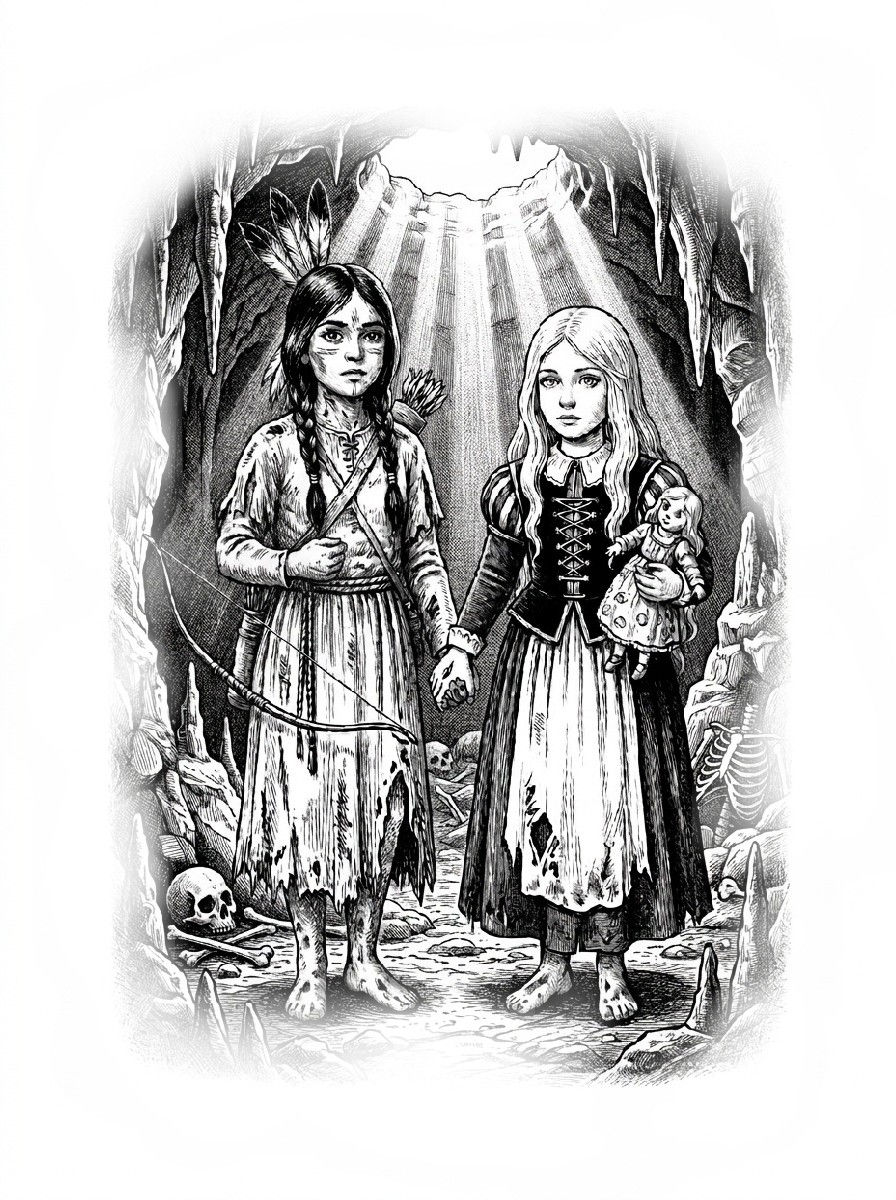
Tacumwah disappeared inside first with a faint rasping scream and Abigail dropped behind her, sliding into the hole under the canopy of sticks and dried leaves. She slid along a small downward chute at a slight angle and clawed at the roots and rocks in the tunnel until she dropped ten feet and fell upon a pile of bones and Tacumwah curled up on the ground next to her, holding a swollen ankle.
They sat looking up at the dust clearing and the sunlight on them, blackness all around in the cave they were trapped inside of. The voices were near, then far, and they waited several minutes to make sure they wouldn’t be found.
Tacumwah coughed and brushed some dust from her animal dress and Abigail knelt to help her stand. Tacumwah rose and shook her leg and Abigail kowtowed to pick up Audry, but Tacumwah beat her to the doll and grabbed it. She looked at the doll and then at Abigail and, “Her name is Audry,” Abigail said. “She’s my best friend.” She wanted to say more about the doll, but she realized, Tacumwah would not understand her words.
“Audry,” Tacumwah spoke, and she handed her the doll. And she didn’t smile. Abigail took notice of it.
Abigail took the doll in hand and then the two of them stared up into the hole above them and the light fell upon them and they wondered the same things, what was up there and how they would climb out, such things, without saying a word to one another.
Kaleidoscopic, the light came through in dissimilar exclusive spaces with leaf bits and plant matter, and a morning moisture focusing a halo on the dust.
Tacumwah left Abigail’s side to examine the dark. Some flickers of flint rock, a few embers and she had a fire going, lit on a small torn piece of material, clothing from one of the bodies in the hole. When the fire lit the room, Abigail staggered backward, only to scream lightly at another body of bones behind her.
The bones were everywhere, animals that may have fallen in and were trapped. Some of the bones were of people, natives perhaps, she guessed. A burial room. A pile of bodies sat roped together in the corner, men in armor and iron suits. Weapons laid scattered about on the floor around them. They were Spanish explorers and they had been dropped into the cavern. Or forced into it and murdered. Abigail searched the corpses and found a tinder box with flint chips and an old wrought iron lantern and she took the fire from Tacumwah and put the burning cloth into the lantern to help them seek a plan of escape from the tomb without burning their fingers.
The air was dank but the ground was dry and it was cold. They shivered and Abigail stripped one of the bodies of armor to look for bits of clothing that might help her keep her body temperature stable. The fabric was thin and eaten away by rodents but a mostly intact half smock was enough to keep her from shivering, draped over her shoulders, and then they made their way through to the back of the cave through some small corridors they had to squeeze through, and stone slabs to duck under. Stalagmites dripped and water on the walls was green with lamp flora and smudges of sulfur and they reached an impasse in the cliff, but there was light in a small tunnel that led upward.
“Niibin ongota,” Tacumwah said, and she pointed up at the sky. Life was up ahead of them and a crawlspace away.
Abigail was picking around for bits of rope from behind them in the corridors, and she wove them in a bundle, tying knots the way her father taught her. In the dark, with flickers of fire, and their shadows playing games on the rock wall, they built a small hoist. They tied the yarn to a staff taken from one of the soldiers and fixed it along the top of the ledge above them near the exit hole.
Tacumwah crawled up and shimmied her way above the cavern and dropped the hoist for Abigail, with Audry dangling from a tie on her waist, and helped pull her up through the hole and out again into the sunlight.
THIRTY SEVEN
THE SHEER CLIFF face was a reminder that there was always something that required she go around it. They stood at the top of the arched rock wall and Abigail kicked a small shingle of limestone off the edge of the stone shelf, and she listened to it skip along the rocks and shatter somewhere in the places below she couldn’t see but could guess about. There were tree tops underneath the ledge and she knew beneath them were more things they would have to maneuver, obstacles that would turn them one way. And then the other.
“Always something to go around. Aunt Alis always used to say that.” She turned to Tacumwah. The girl nodded along as she picked at the fine strands of fiber along the run of rope on her bow, and Abigail thought she might have even understood what she was saying. “If we could turn into birds, we could fly right down to the bottom,” she added. Then she turned to Tacumwah. “But only little children believe in that kind of stuff.”
She slowly passed an eye toward the native girl and Tacumwah remained still and she said nothing. Abigail looked at the doll in her arms. Audry’s smile was a reminder that the world around her wanted to fool her eyes. For what other purpose could it be smiling, if not to remind her that there was no reason for it, the smile. She looked at the doll again and she closed her eyes. She felt the weight of it. It felt like she had been carrying around an enemy dressed as a friend, and the smile on Audry’s face was all of a sudden much more sinister when she opened her eyes again.
She placed the doll down on the edge of the cliff, by her two bare feet. She looked at Audry again, she would never forget that smile. A reminder never to smile like the doll, and never trust a smile. Something she would always go around, if somebody smiled at her. The smile. Always go around it, she thought to herself.
“Goodbye Audry,” she said to the doll and she looked away into the distance. The skies were wide open and nothing was written inside her mind, and she didn’t know what to do but fill her eyes with the clouds and the sunlight. She closed them. Then she opened them again.
She looked at Tacumwah. The native girl looked at her and nodded. She wore no smile on her face and Abigail intensely knew that Tacumwah understood her.
“Come on, Tacumwah,” she said. “Let’s get on with it before the smiles get us.”

THIRTY NINE
HIS FACE NEVER contorted, not from the moment the arrow tip penetrated his ruptured eyeball, from the back of his skull, nor at the moment he clapped against the earth. The distorted smile on him remained, as he hobbled forward for several short paces. He collapsed and fell, in a quiet splash of mud and fir needles.
Abigail looked up from the dead native, a small man with a high cut mohawk, and many wrinkles on his face, and she stared at Tacumwah. The little native girl kept her chin high and her eyelids aimed downward, and she held her bow in one dangling hand, and she slowly approached Abigail.
She reached out her other arm and pulled her friend to her feet. The two girls brushed dirt from themselves and fell into a small routine of young girl things, and they regrouped and gathered their wits. Abigail found only tree leaves and a soft wind when she reached into her thoughts for the journey ahead.
“Awaten,” Tacumwah said, and she motioned her hand with a finger pointed down, to turn around, and Abigail spun on her heels for Tacumwah to rub dirt off her back and tie her hair in a small bun.
Her blonde locks fell into long clumps and Tacumwah tied the mane several directions, in a braid, and then she slipped a cord around the hair knot. Abigail closed her eyes. The air was musty.
She let her thoughts wander and a native popped into it and her eyes opened and he was there. Across the hillside, standing in a clump of blueberry bushes and scanning the horizon with his fingers above his brow.
Tacumwah tugged on her back and the girls slipped down to knee level. They crouched and ducked under some bushes and crawled along the undergrowth, gripping rising tree roots, scraping over rocks, and moving like two small creatures of the forest, until the trees grew thicker for them to cover in. They rose and they darted fervently into the woods. From behind they could hear a native, “Peyakwan,” he called, and then more natives called out, and soon they were calling out again, in the distance. The girls continued to navigate the forest, for nearly an hour, scampering through brush and tall meadows, climbing along hillsides and keeping to the shade and covered areas of the woods. They moved in silence and with haste, and when the air was quite still, and the skies were empty, Tacumwah slowed Abigail and they spied a small creek to wash in.
The cold dry river forked and regained in width along mud banks and fern beds, and it disappeared around a sharp cove of rocks.
They made their way toward the water, and in a staggering fall, Tacumwah stumbled backwards, on Abigail, trotting behind her. Abigail caught her, the two girls looking up at the tall native.
He wore a tie around his head and his cheeks were heavily pitted, and behind him two more natives appeared. The girls backed away cautiously, keeping to the edge of the brook, and they watched the natives standing about and watching them. They were a different tribe. Wanchese’s men, perhaps, Abigail thought.
When the ground grew stiff again and the brush was light they spun and made their way into the woods hurriedly. The natives never advanced.

FORTY
THEY HELD THEIR breaths in, and they squinted their tired, mud-covered eyes and Abigail pretended she was a dusty old boulder stone, squatting and hiding in the bushes. It felt like an hour, or more. She shivered and she rubbed her arms with her cold hands to try and keep warm, but the cold skin against cold, clammy palms, brought sweat under her armpits, and no joy, or warmth to her fingers. They waited long after the voices dwindled and the sounds of natives pursuing them changed from quiet talk and chatter to birds singing and branches falling from high trees into the brush.
Abigail rose to stand and Tacumwah cuffed her arm to keep her hidden, more time to make sure the woods were clear for them to move along on a new path toward the settlement.
From far off, a wolf howled and yapped, and it sounded like there might be more than one, and Abigail shivered and Tacumwah looked her over, noting she was tired and hungry and they had ground to cover and the air grew dark and it smelled of a rainstorm approaching in the early night.
They stood and walked near to one another until it grew too black to see through the forest, and the tangles of shadows were lighter apparition than the air around them.
A small embankment gave way with some broad tree roots that corralled a flat area of pressed clay, and when cleaned of leaves, it was practical for them to huddle together and keep warm from the night breeze.
They lay together, Tacumwah on her stomach and Abigail cloaked around her from behind. A wolf called again and the moon gave way from a patch of clouds, and the native girl hummed a tune and drew in the soil with a stick. She scrawled the shape of an animal with pointed ears and a long snout and, “Wolf,” Abigail whispered to her. “My father has hunted and killed at least ten of them since we arrived.”
Tacumwah turned her head for a brief glance, and then she went back to scribbling shapes of wolves dancing in rings in the dirt.
Abigail thought about her father and a band of fierce visions circled inside her mind, and she saw her father, John White, and Simon Fernandes, on a boat, voyaging across harsh weather waves, under the same pale moon, and her father was looking over the side of the ship stern, out toward her, watching from above him. She wanted to call out to him, but she couldn’t open her mouth, nor her eyes, and soon, only the waves remained, and they took her under, into sleep.
LIKE SMALL REAVERS, they arrived sometime in the morning hours and stole several acorns that Abigail had gathered to nibble on, during the previous day’s walk, right out of her rear dress pocket. They were field mice and they scattered as evidence of their crimes in the dawn sunlight.
“Nda ni wi sinaganan,” Tacumwah said, taking note of her tiredness and growing hunger. Abigail understood, they had to be moving on.
They marched through swampy brush land and wet open fields and came through a small forest with a long, low ledge of rocks, with jagged cedar trees in the ditches along the edges of the ridge.
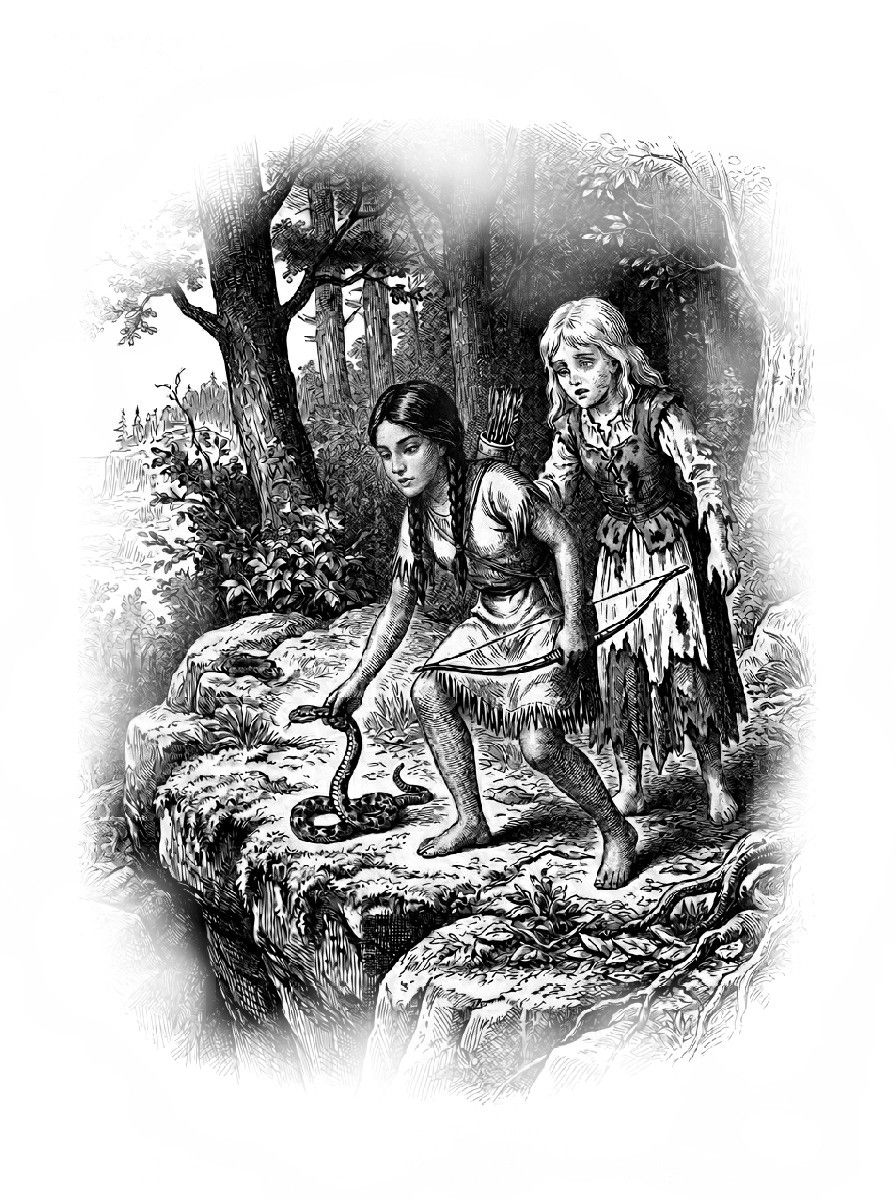
They walked through the stones and something struck at Abigail’s ankle, and she hopped away to avoid it striking again. It was a snake, and suddenly, they were all around her. More snakes than she could count. They had tails that rattled and she knew them as the dangerous ones that caused sickness, and sometimes even death.
Tacumwah approached one of them and grabbed it by the tail in a swift dart of her fingers, and she dangled it as it spun and snapped at her. It missed and then it quickly calmed. She tossed it down along the edge of the rocks, and went for another. And another. She removed three of them from their path, and then, “Kaawiindii wiikaa giishpin,” she said, shrugging and motioning for Abigail to follow her. Abigail shrugged also and tip-toed along the open rocks, stepping around several more snakes as they slithered and some lay still.
At the far edge of the rock embankment, they dove around and descended into another dry swamp, and Abigail felt a rush of energy under her feet.
They scampered swiftly in long twirling leaps, and Tacumwah hummed some native tunes in quiet hymns, and they covered much ground.
The marshes grew deeper and soon they stood knee-deep in dark brackish water along the edge of the river that fanned open in a broad channel that met with the sound. Tacumwah collected several buoyant logs and she strapped them together after tying some cordgrass in woven, knotted ropes, and Abigail clung to them as they made their way across the water with the small native girl along the back of the float, kick-swimming and pushing their raft through the waves. The sun showed and the water grew deeper and Abigail could see shapes in the water below her. She pressed her face into the liquid and she opened her eyes and a monstrous alligator lizard hovered not more than ten feet below the logs, moving with the current along the bottom. It looked to be twice as long as the make-shift raft they clung to.
She watched it without a rise in her heart, and no fear in her thoughts, shifting its tail, to slip away into a dark, muddy trail of river weeds, and the empty water felt comforting.
SIXTEEN
IN SORROW THEY marched inland. They were told several times that they were being ushered to a place in the native tongue that translated to, where morning never comes, Manteo called it. It was a ceremonial ground, where some of them would be judged and made to pay for their evils and the rest of them would then be freed, to return home to the island. That is what Manteo told them. Chief Blackbird, his name was, the English word for Chogun, and he was angrier than any man Abigail had ever come in contact with. His deep hatred was evident in the many fine wrinkles on his face and the permanent downturn shape of his eyebrows. There was a fire sweltering inside his mind and his eyes were always focused and intent. She guessed everywhere he put his eyes the anger in them did something to the place he put them at. When his eyes found her, she felt the fury, and the impression burned a reminder into her thoughts that lasted long after he trotted away to appear somewhere else and watch over his capture.
The other natives totaled over fifty and they kept spears and guns on the settlers and some of them bound in ropes and others gagged with bits of tattered clothing and strips of pelt.
“I’m scared, Abigail,” Margy said. She whispered it.
Abigail nodded. “Me too,” she said. She looked down at Audry, clutched in her fingers. The doll fashion baby was ripped again at the shoulder, leaking thickets of wool roving. Her Aunt’s stichwork was unraveling. The doll never took an eye off of her. “Here,” she said to Margy. She pushed the doll at her. Abigail dangled it in front of Margy and did her best to force the doll on her, but the taller girl wouldn’t take it. “We’re going to need more than your doll to escape from this with whole skin,” Margy said in a whisper.
Abigail waited. “I know,” she said. “I just wanted you to know that I would give her to you,” she said, and she stopped to look at the ground. Her feet felt like a motion of nothingness hovering below her. “I just wanted you to know, if I could give you something to make you feel well, I would.”
“Thank you, Abigail,” Margy said. Abigail looked at the doll. The smile was inappropriate. She couldn’t stand the smile. She wanted to cut the smile off and pull the doll’s eyes out.
She dropped Audry to her side and she pranced on with the flock. When Audry caught a bush or a clump of mud, Abigail let it be.
The trees thinned and the branches kept higher on the trunks and they parted for a small grass field and the green was still fresh from the summer and dotted with limb failure, dying yellowing ferns tall along the thickets. Deer droppings smelled fresh and there was no wind.
Chief Blackbird and his guard Nanan and another warrior stopped along the far edge of the field and halted the group. He spoke something in his native tongue.
“We stop here to rest,” Manteo said.
“Some of our people require usage of the privy house, so to say,” Chaplain Marmaduke Fernsby said.
Chief Blackbird spoke again. “That is fine,” Manteo said.
Several natives called out commands and worked in teams to divide the weary settlers into smaller groups to take them to the edge of the woods to use the jakes. They moaned and fretted and some of the men cursed and one man said he would use the bathroom right there, with everyone watching, if they pleased.
Abigail noticed a younger native girl, with lighter hair, almost orange, with freckles on her face. Her doe brown eyes with green streaks in them had no sparkle and the sadness in her looked like it had been sewn on her, in all opposites to Audry. But she looked like, as a young girl, she might have been happy.
“Look at her eyes. Green as a cat that’s been feeding on lye from a chamber pot that hasn’t been mucked out in a month,” Colman said. He whispered it to Daniel Warren.
“She must be a Spaniard. Probably a captive from the Franciscan expeditions,” Daniel Warren said.
“They stopped drinking lye there centuries ago, I heard,” Robert Marshall said. “The Cats. Not the Spaniards.”
Colman and Daniel Warren snickered.
“Must have been taken as a sweeting,” Colman whispered.
Abigail listened to them speak about the young native that looked Spanish. She glanced around at all of the other settlers and she couldn’t help but notice that the meadow was full of tired eyes and the glum faces of her kin. Aunt Alis and Uncle Silvester remained close together. A young native warrior kept an eye on her aunt and she avoided his gaze and tried to keep him away as he grabbed at her dress, fascinated by the fabric in his fingers. From behind, several natives were laughing, and Emma Dorrell was cursing them. Abigail turned to find her stooped down in a bush and trying to upright herself. Her britches were pulled down and her dress was torn and she having trouble rising. The natives mocked her and laughed and the shadows from the forest fell upon the shapes of other settlers and natives in similar predicaments.
From the front of her, she could hear Ananias Dare speaking with Manteo and Chief Blackbird. John Gibbs stood to the side of Ananias, along with John Hewett. John Hewett was bound in ropes and wore a gag around his neck, pulled from his face.
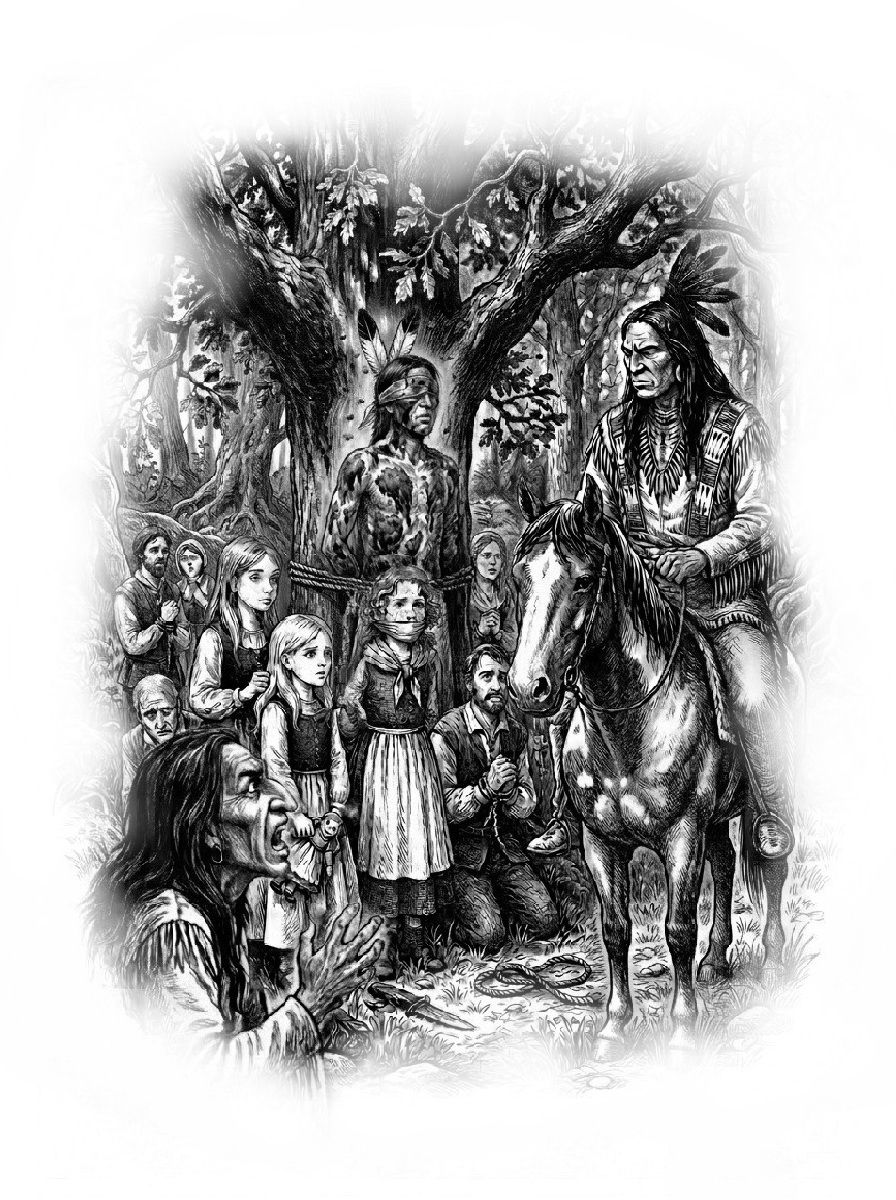
“Who is it that beheaded Wingina?” Blackbird said. He sat on his horse and towered above the others. They were on foot.
A long pause was ended with chatter from two men. “Edward Nugent,” John Hewett and Ananias said, almost in tandem. “He is not with us on this expedition,” John Hewett added.
“Gookamesh,” Blackbird said. “Why is it that some of you vultures have left, but more of you have come? I guess it is the vulture that only leaves to scavenge and plunder, before he returns to his home.”
“Ahh, but so does the snake,” John Gibbs said. “But we have a way of dealing with snakes, where we come from. Cut the head off of a snake, and he won’t bite you, hitherto. Cut the tail off of a snake, and he’ll die. After a long agonizing death of trying to wiggle his end back to where he came from. Isn’t that right, Manteo?”
Chief Blackbird hopped to the ground in a small leap, landing in a semi-squat. He reached for the gun in a saddle on his horse. He walked over to John Gibbs, swung an arm over his shoulder, and put the caliver at his nose.
“"Matci manito. Kije kinose wiwesiwen, mina n'kackike otakemikonan, kidji n'tah kikakonam, peyakonam kakina n'pihtokwehkewin," otah Manteo e-kishkinohamat,” Blackbird said.
“Chogun says you are a thieving devil. And you either do what he tells you to do, exactly what he tells you, or he will take your brain out of your skull and jape it, and put it back inside, when he’s done, still wet with his many children that will never be.”
“Please,” John Gibbs said. His head was still twisted and looking up toward Chief Blackbird. But his eyes couldn’t see past the fingers pressing into his cheeks. He strained his eyes to look up. “Just leave our families alone. Take my body as a sacrifice, but our families. Please leave them alone. I can assure you that they will giveth you no problems from here on.”
“I’ll giveth your family problems for the next thousand years, if I please,” Chief Blackbird said. He let go of John Gibbs. The older man fell to the ground and heaved. He drew in a long breath, let it out, then struggled to rise. He sat on his knees and Abigail thought he looked like a sick animal that had been captured in a net or a trap.
Wisimingas approached. “Chogun,” he said. “I know better than to offend you, our people have been close for very long. But I cannot allow you to do this to our people. My people. The good people of Roanoke. Not without first being heard.” He turned to Manteo. Manteo looked away. “We must do something, Manteo,” he said.
“I did not know that it would come to this way,” Manteo said. He turned back toward Wisimingas.
“You’re a traitor, Manteo,” Wisimingas said. He spit on the ground.
“Achak,” Chief Blackbird said. “He calls us traitors, but he is the traitor to us. Show our small friend what we do to those of us that betray our beautiful people, for an unclean evil people that behave like vultures,” he said.
A lofty dark-skinned native with feathers in his head, called Achak, carried a high mohawk. It descended into long hair, in a tie, dangling from the back of his head, and he wore a slight grin. He advanced toward Wisimingas and nodded at Blackbird. Two others joined. Wisimingas cursed as they threw a pelt over his face and dragged him toward a lone tree off to the side of the field. Abigail watched them tying him up.
He writhed and yelped but the pelt kept him from saying anything tangible. The thin tree took his fury and shook and near dead leaves sailed downward as he pulled and hollered, and when he was tied up, with his feet hovering a meter up off of the ground, they removed the pelt and strung a rope around his mouth. Crucified, he moaned in short increments.
Two natives arrived with human waste in their hands. They laughed and made faces, feigning sickness from the smell of the waste, as they spread it on Wisimingas. They spent a long minute wiping the waste on him, coating his arms and legs and chest. Then, his face. Another native showed with a small pot of urine. He doused Wisimingas and the others laughed and the settlers were horrified. The warrior named Achak stood and laughed, and then approached Wisimingas. He took the native boy’s cheeks between his fingers and he shook his face and then he put his hand up and waived it in front of his face to signal the foul smell. “Animosh kije manitou,” Achak said.
Nobody said a word. Wisimingas moaned some but gave in and his head hung as they shamed him. Before they finished, the flies showed. Small bugs with wings, and larger ones. And bees. They swarmed and Wisimingas shook in a fury and screamed out. But his mouth was gagged and the tree shook and more flies and bugs arrived and the torment was enough to force Abigail to look away. They listened to him scream and it turned to raspy moaning and the sound of his cries eventually ceased. She settled on the thought he passed out and the pain was no more. The sounds of the bugs intensified and a tear slipped from her eye and slid into the corner of her mouth and her lips parted to welcome the bite of brain water and the salt on her tongue was almost sweet.
“You can’t do that,” a small voice called out. It was Wenefrid Winterbourne. Abigail turned to find her friend with tears streaming down her cheeks. Wenefrid parted from the group and sidestepped away from the natives guarding her with spears, next to Tom Ballin and Philip North. “You can’t do that,” she cried.
Chief Blackbird approached her. He reached out his left hand and cupped her chin. He looked as if he might kiss her. “Yes,” he said. “I can do that.”
He nodded at one of the natives approaching her from behind. The native slipped a noose around her and took a rock in his hand and mashed it into her face. She opened her mouth and the rock slipped inside. It was big enough to make her gag. He pulled the noose high around her face and tied the rock in place, with several loops of the rope around her head, then bound her wrists with another piece of twine. The rope pulled on her nose and left her looking like a pig. The native made the sounds of a pig grunting and mocked her and pushed her on the ground. Wenefrid fell and rolled up on her back and her eyes turned upward and toward the sky in a silent scream. Abigail could feel the scream.
“No more,” a voice called from behind. It was Manteo. “I cannot stand here and watch this. I have gone along with this for too long already. I do not care what you say, it means nothing anymore. If you say you will spare them, I will not believe you. This is enough, Chogun. I will fight you now if I have to.”
Chogun turned his back to Manteo and spoke. “You were once loyal to Wingina and the rest of the Secotans, even going so far as to travel to the land of these vultures and eat at their tables and listen to their lies. But only to bring us information. And now, you want to die for them?”
“Our people have fought their people for long enough, since they have come to our lands. In England, I came to understand, the only way to go forward is to accept these people. And many of them are as good to me as any of our people are. No matter our differences,” Manteo said.
Chief Blackbird turned. He walked beside Manteo and then in front of him. He stopped and turned to him. He looked him in the eyes and stood in front of him and didn’t waiver. “You have seen their world, and the many things they bring from their world. And there are still many things you do not see.”
“What would you do to me, Chogun. Cut out my eyes and then blame me for being blind?” Manteo said.
“No, Manteo, my brother,” Blackbird said. “I will not blind you. But I will make you see the light of the sky.” He paused. “And never will you stop seeing it,” he said.
Chogun pulled a small dagger from the sheath hanging along his belt. It was a clear crystal knife point, chiseled away with chips and folds in the quartz. Two more natives joined and took Manteo from behind. They brought him to the ground and held him toward the sky, over the folded leg of one of them. Manteo did not fight.
Chief Blackbird stooped to the ground on his knee.
He put the crystal blade point to Manteo’s eyelids, and before he cut them both off, with two quick slices, Manteo screamed.
TEN
THE MEN BID a short farewell, with somber expressions, a hook of their hands above their eyebrows, and the smell of their morning tobacco trailing. They walked in a single line, and not a mob, out of the front gate, and Abigail thought they resembled a small infantry of lost, tired children returning from a lengthy day playing in the woods. But they were headed to the woods, and it was Manteo guiding them in his best native garments and with a short musket angled upward on his shoulder and everyone in the village stood quiet in vigilance and with care for the brave journey ahead of them. Thirty-two of them, including Manteo, a few more than one quarter of the settlers. The sun hid and the birds were quiet. Pale streaks of white haze collected above the trees and there was a moist feeling tarnishing everything but it had not rained in days.
They were destined for packed rafts, to sail the sound and visit the neighboring tribal members on Croatoan island. They were sent to beg for help in the town’s plight for nutriment. Abigail remained with Audry in her arms, as some of the settler spectators fell away.
She watched the band of travelling men as they hurried into the distance, imagining the boats in the water, rocking about, and the natives beyond, collecting on the shores to greet them with all of the many savory foods she could taste, in her mind, but hadn’t eaten for well over a week.
John Gibbs, the fort head guardsman, thought it best to leave the gates open, out of respect for the men, and many of the settlers mingled and talked as they trod on the dirt, and one of the horses carrying a parcel of supplies laid a fresh clump of manure and the stench of stale hay lasted, longer than she wished, so she moved to the far side of the fence. It drew a new perspective, in the shadows by the gate house, on the same situation. It was like a painting, one of John White’s impressions, when he washed the oak board and scribbled scenery with changing people, moving the angle before he put the paint on his brush and brought it to life with a smear of pigments. She listened to the settlers talk.
“Bring them on this side, Beagle,” John Gibbs said. “On this side. Those mongrels haven’t eaten in days, and if they get in the pens, the last of the pullets are going to smell like slaver from the mouth of a three-week-old corpse rotting in the laneway.”
“Matty,” Wisimingas called to the dog. “Matty, I told you, many times. Ojirbwe.” The dog howled and danced around his legs and licked at his thighs and hopped up to claw at him. Wisimingas took the dog and wrestled his paws and pushed him down and patted him on the head.
“He is a fine dog. And please, Mr. Gibbs. I asked that you call me by my rightful name. It is Wisimingas. Not Beagle.”
“A fine dog, eh? You trained him well. Aside from the leak he leaves all over the wood piles behind the gatehouse, I can smell it every marry time I go behind there to leave one of my own,” and “Wisimingas,” he said with emphasis.
“It’s yours you’re smelling, Gibbs,” Colman said. The older man walked by with a lone perch fish hanging from a spear tip and a tight woven weir dangling from his other arm. The net was empty and heavy with knots.
“I could leave one in the channels and catch a finer fish than that wee elf-skin of yours. Bigger, certainly, than the wee one on that spear. Which is magnificent in comparison to the penury one under your belt.”
Colman rolled his eyes and walked toward the rear house on the path that meandered the long ways around Assembly Hall.
“Matty is fine and he never goes in the chicken fence when it is open,” Wisimingas said. He crouched to pat the dog and the dog shook his fur coat and circled the boy and panted.
“Marvelous work, Wisimingas,” John Gibbs Said. “You want me to rip open your chest and kiss your marry heart?”
“Just not this name, Beagle, anymore. Please,” the boy said to the man. “Wisimingas means coyote. They are sacred in our culture. Dogs are friends in yours, but it is the wild in the coyote that makes him untamable and the word you call ‘liberty.”
“Right,” John Gibbs said. “They have about as much liberty as I have to hold it in until my veins fill with blood and my liver is poisoned and I have to leave it in my pants, but I guess you do a better job than a stinking neger boy, and for that I shall hold my swallowing.”
Wisimingas shook his head and patted Matty, the dog, again.
Abigail watched the boy and the man exchange small talk, about the dogs and the chickens, and the bandogs pranced and howled about, and the chickens fluttered their wings and one hen flew to the fence posts and the people fretted about the front gates. From behind, “Hello, Abigail.” It was her friend Margaret. She was with Wenefrid, by the arm.
“Well. Hello Margy,” Abigail said. “And to you also, Wenefrid,”
“Hello, Abigail,” Wenefrid said. “We heard about your most marvelous lecture at the meeting yesterday.” Wenefrid raised her eyes and fluttered her lashes and made a face like she had sucked on a bad lemon peel. “We heard it was,” she turned to Margaret. “Intriguing,” she said, after a moment of thought.
“Intriguing? That’s an interesting word. Where did you make that one up?” Abigail said. “Has Wisimingas been teaching you those blasphemous Algonquin curses again?”
“No,” Margy said. “Really, Abigail. Intriguing is an English word. It means interesting.”
Abigail stood still. She winced, then she looked at Margy. Margy fluttered her eyes. “Now you’re taking her side?” Abigail said to her. “You’re supposed to be my best friend. Not hers.” She stuck her tongue out at Wenefrid.
“No, Abigail,” Wenefrid said. “You misunderstood us. It’s a compliment. We heard what you said was interesting.”
Abigail was stuck. She had to play along. They were the only other girls her age. Jane Taylor was the other, but several years older. And then the Mill twins, Agnes and Mary. But they were eight, and they never left their mother’s side. The only other girls were Ambrose Chapman and Rose Morris, but they were women already, in their late teens. She had to play along.
“Well,” Abigail said. “In that case. Gramercy Wenefrid. And you as well, Margy.”
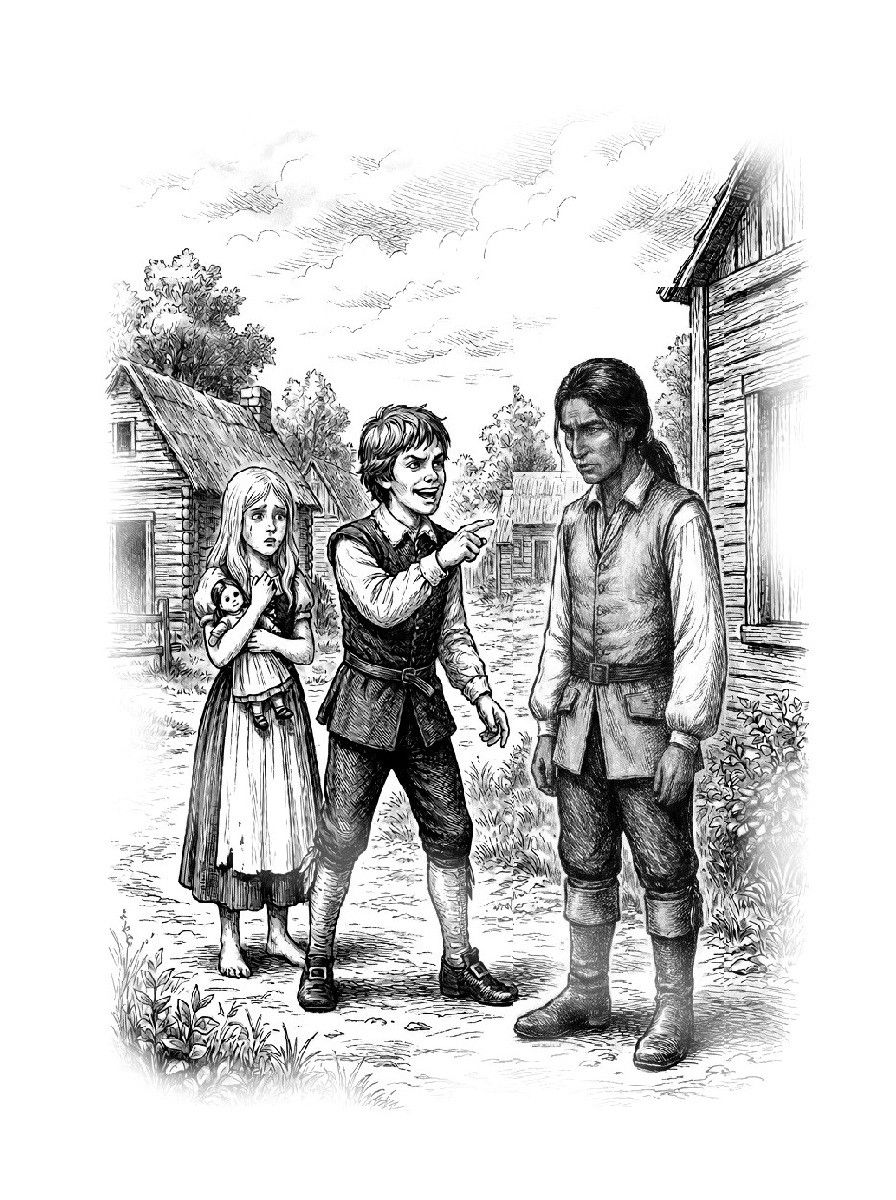
“Your stupid doll’s your best friend,” a voice said. “We all know that.” It was George Warren. He appeared near them and caught Abigail and she skipped back an inch and nearly tripped on her blouse in her surprise. “And your intriguing speech was an annoying bout of blather. Tom Ballin said you must have gotten into the Chaplain’s wine for sacrament, or that you were hallucinating from this famine. That, or just looking for attention again.”
Abigail listened. She could say nothing. She felt a tear in the corner of her eye and a strong, burning sensation in the pit of her stomach. She wanted to scream. It was painful to hear George say it. She didn’t know why it mattered so much, but it did. To hear him teasing her like that.
“Leave her alone,” Wisimingas said. He came from the shadows. Matty trotted along next to him and nipped at his heels. The taller native boy took slow steps toward Abigail, behind her, and he stopped by her right shoulder and he looked down at George, a half foot shorter. Abigail looked at Wisimingas. In his dark brown eyes she saw compassion. It mattered to her. Not more than George’s insults. But it mattered. And yet she didn’t quite understand it. And yet, in some sense, she did.
“Hello Beagle,” George said. Abigail turned to spy the other boy. “How about you hold my pizzle while I prate with the ladies. And when I’m done, you can shake me off and mount and ride away on the back one of those dogs, into the sunset. Where you came from.”
Abigail and the two other girls watched in silence, moving their eyes from one boy to the other.
“I thought I told you, George Warren. My name is Wisimingas. I will call you Mishabohqaus, from now. It means filthy rat, and in our culture, you can be no worse than that. And I will make it your name. Mishabohquas. If you continue to call me by any other name than Wisimingas.” He pushed his chest out toward the smaller boy and raised his chin.
“Beagle,” George Warren said. He tilted his head and his eyes got mean and squint. He puckered his mouth and he lifted his arm and he pointed a finger toward Wisimingas. Then he let it fall. And then, his arm. “You just don’t get it, do you,” he said. “You’re not one of us. And you never will be.” George Warren turned his back and walked off, “You’re a lowly dog,” he said. “An animal with no understanding of our people and why we travelled all the way to this God-awful place,” he said. Another moment, he turned, to speak over his shoulder. “To spill your people.”
THREE
SHE KEPT UNDER the cockeyed window frame. Her fingertips caught the front weight of her upper body, crouching and bent at the waist, her legs lolled. Her doll sat against the wall, stark next to her. She listened. The wood below her was wet and cold and her slippers were slick at the heels and her dress was soaked and the shivers were becoming shakes and stiff muscles. It was worth it to know, always something to know that she wasn’t supposed to know. That was life. Knowing before other people knew, so she knew what moves to make before they did.
Her first move was to fix her gaze on a small crack below the window bottom board that lent her some sight over the situation.
The voices filled in the rest.
“You can’t be serious, John,” Arthur Mason said. He looked at the arquebus in his hand, down the barrel, sighting it and then taping it against the table and letting it sit as he rubbed it with a rag. “Surely you’ve misunderstood what Manteo is saying.”
“I am misunderstanding nothing, Mr. Mason.” John White was quick to respond. “We’re either going to leave by the week’s finish, or we’re going to ration things, strive against the stream, and move about as little as possible until the season passes, to make sure that we survive. And those are the choices.”
A higher voice finished at the end of his sentence, without pause. “The final choice is Croatoan. But I think you have already said that this is not a good thing,” the smaller, younger, native said.
“Quiet Beagle,” Arthur Mason said. The tip of his finger pressed against the nose of the gun, balancing it on its end against the table. He looked at the older, wiry, native with the long legs and many wrinkles in his face. “Let Manteo speak for the native counsel. Last I checked he was elected spokesman for the great leaders of the new world. Isn’t that right Manteo, my friend.”
The older Native nodded, slightly. It was evident they had all been drinking a bit.
“Beagle,” John White said. “I’m very interested in what you have to say.” The other men were quiet.
The small native stepped forward from the dark of the room toward the table where the men were sitting. The candle brought the shadows over him to accentuate the tattoos and paint on his body and darkened the deep pockets below his eyes. The white of them glowed.
“We have friends at Croatoan. I know them well. And their methods. Well,” he said. “They may not have provisions to last through the winter, but they will have enough to keep us until we can find more food. There are elk and rabbits to take, plenty in the snow time. We know this well, at Croatoan. They are a good people and a tribe that, how do you say, can, barter. Fairly?” Beagle looked at Manteo, the older native. The men were silent. John White looked up at Beagle. The other three men, including the older native, Manteo, sat with their fixed eyes toward the table and collecting the candle light on their solemn guises. “Also,” the young native spoke. “This word Beagle that you all like to call me now. My name is Wisimingas. And only Wisimingas. I am not your small dog for hunting.”
John White smiled. “Wisimingas,” he said. “And Beagle never again.” Manteo, the older native, smiled also, keeping his eyes down, set on the table top.
Abigail knew and liked Wisimingas. His name meant coyote, or small wolf. But the others liked to call him Beagle. Because he was always smiling, happy, and following around Manteo, the much older native. He was young, in his elder youth. Always following along, faithfully. Like a small dog, she thought.
“Let’s all lose our heritage this winter, along with our lives, does anybody else agree with me?” Arthur Mason said.
“What do you think, Fernandes?” John White said to the older man with the pointed mustache and fierce, dark eyes.
“How about another sip of Brandy,” the man with the dark eyes said. “And then, I will tell you my thoughts.”
John White nodded. “Wisimingas,” John White said, politely and with a very cautious, delicate tone. “Would you please?”
The young native nodded and stepped forward to grab the bottle and he made his way around the table to pour the brandy wine.
Abigail took the moment to reposition herself, being cautious of where she shifted. The boards were wet and a creak might give her away. Below her she could see the lower deck, where George must have been sneaking a few drinks from the brandy and other liquors that were kept cold in the store rooms. His uncle Daniel Warren, a tannery master and carpenter, had keys to the building, she knew. This must have been where George was sneaking away with the alcohol. He once told her how he snuck some alcohol from the city market when nobody was looking and that he drank so much, he passed out in the wash room, and woke up, so wet with wee, that he had to toss his clothing and wear a sheet home.
The open doors and the fire inside the fire places was high and she guessed the men in the room beyond her were downstairs at one point, perhaps with George below the window, in a situation not so different from hers. Watching and waiting for them to make their way to the top floor. Charter Hall, they called it, and it was where the meeting was being held. Abigail gazed below her again. The flickering put light up through the cracks in the boards under her. She slid on her palms, fingers bent in hooks, and she shuffled back several paces in a short burst, and then pushed her back against the wall to breathe heavy, several times, before she turned to find a wider gap in the wood. She looked over at Audry, fallen and lying sideways on the planks, and she propped her up against the wall again.
“You don’t need to be spying also, Audry” she said to the doll. Abigail pressed her nose against the wall, sighting through a knot in the wood, and watched.
When the drinks were poured and the men had the cups in their hands and they were sipping their brandy, Simon Fernandes, the man with the dark eyes, spoke.
“Walter Raleigh, on our egregious journey to Guina, once told me that to set out for an exploration and not plan for all obstacles is a better deal more swell than sitting around with in a thumb in one’s posterior and hoping for the world to come and tell you the news,” he said. “Who knows what shall come, either way. But one choice leaves you with one less finger to sniff. And one, to sniff harder, than all the others.” He lifted his thumb in the air.
The others waited and then chuckled.
“Then again,” Fernandes said. “Our adventures weren’t even successful enough to bring me the fruits of a new wife, or a child. So much for exploration of all those caves we thought might hold a horde of gold and jewels, the native women we met on our journey, from Parico, to Punta de Carao, to the Yucatan. All the many of them, kept away from our fingers, as they did the rest of us. Except when we had gifts in them. Whereupon, the noble wives, daughters and concubines of unsaintly lords, they, of course, wanted us to have a heart for them.” He paused momentarily to lift a pipe out of his pocket, lit it with the candle and puffed on it. “So they might rip them right out of our marry chests.”
“Aye marry, Fernandes,” Arthur Mason said. “How did you get by that one?”
“I put a pineapple in there.”
The men chuckled some more.
“Well, that settles it,” Arthur Mason said. He jabbed the gun butt in his hand, firm against the table with a knock. “We set sail this weekend.” He looked at John White, intently. “With pineapples in our hearts.” A few more chuckles.
Arthur Mason was good at finishing thoughts and conversations, and forcing agreement with people. She knew it well, Arthur was Abigail’s father. He was an under captain of John White, captain of the ship and one of the heads of the settlement. Her father was a skilled carpenter and a keen military strategist. He served two terms as a commodore in Queen Elizabeth’s royal army and was quickly becoming one of the lead interpreters at the fort, working closely with Manteo, one of two Natives that had crossed the seas several years prior, and made a return journey from England with their party. The other native leader, was called Wanchese. A leaner, more athletic native, fierce, his eyes almost protruded from his skull. He wasn’t as interested in the settlers as Manteo was, not even when he lived in England. Abigail felt he was untrustworthy and an angry man.
The two of them, as like and unlike as they were, fully assimilated into English society, even wearing normal English men’s garments when exploring the streets and shops of the old world, but Wanchese was quick to return to his ways as soon as they all boarded. He kept apart from the English and only wanted to share conversation with Manteo, and John White sometimes. He had a hostile way about him. He had been gone from the settlement for months, visiting other tribes in what they called ‘Native political relations’. She was fine with it. This left Manteo with more to say and to decide.
“I think the storms this season, on the seas, will be more of a problem than first sailing to Croatoan and seeing what they can offer us. But I will not speak against any of your wishes John, nor hinder you in a swift departure,” Manteo said.
Abigail liked Manteo. Near chinless, with kind, dark eyes, puffy lids, a beaked nose and long, dark hair. He resembled an old bird, to her. Not so unlike the men from the far east, in a land they called Cathy, she had seen these men in drawings. Manteo was quiet and patient. He was also a curious man, and polite, very much unlike most of the other natives that she had encountered. Most of them were skittish and not very friendly. She had been told if she ever saw one outside the fort, to avoid making eye contact, or verbal contact, and to alert the guards at the fort as quickly as she could return. Only once or twice did she think she saw one, never quite sure if her eyes lied. She remembered George, and wondered if it might have been a native that she saw in the fields earlier that day. That was how she was told they were. They moved silently in the high brush and kept their distance, like foxes and small wild dogs sometimes showed their ears, protruding above a mound of grass, and were gone in the twitch of an eye whisker. Rarely did they visit the island, without prior warning, the leaders of the settlement were told, by Manteo and Wanchese. And the leaders liked it that way, to know when the natives were going to show, before the others. Before they came to visit and barter goods, or negotiate for other purposes. But Abigail could tell, the natives did things their own way and were likely visiting the island without announcement all the time.
She was, in fact, when she thought more of it, intrigued by the idea they might be watching her, and she took pride in the idea that she was bold enough to not fear the idea. When she thought about it more, she grew braver. When she bathed at her secret brook, she thought about it often. Peering around into the forest. But she never saw one, and had no reason to believe they were there. She felt brave sometimes and pretended that they were. Watching her from all spaces.
Manteo was the very opposite, in all respects. His eyes were always focused on anything he could tinker with and learn about around the settlement, tools and books and embroidery. He mostly kept from direct eye contact with the others, but he wasn’t afraid of the English. Certainly not the type to spy from a bush.
“I do have one final thing to say about this though. Whatever you all should decide,” Manteo said.
In his manners, Manteo wasn’t quite one of the settlers, but he spoke proper English and showed true loyalty to the leaders of the residents of the fort. Abigail knew that he was probably more correct about most things in the new world than her father, or John White, or any of the others. Manteo was wise and skilled at many things. She knew he carried more weight in the room than anyone but John White, including more so than Arthur Mason, her father.
“We have an old tale we tell in our tribe,” Manteo said. “There once was a man who lived in a cave, merely to spend his life screaming at a tree outside of the entrance to it, each morning when he awoke. People thought him mad, and asked him what he was doing. He said he was screaming at the tree to fall down on a personal quest to become powerful. And after thirty years, of screaming at it, every morning, the tree fell.”
John White looked at Arthur Mason. Simon Fernandes sat with his arms folded and his eyebrows shut over his lids. He looked intimidated and drunk by all of the talk.
“Was it a pineapple tree, Manteo?” Arthur Mason said, looking at Fernandes, all of them giggling, briefly, in raspy, drunken tones.
“This means you think we will make it across and return if we are hasty and intent,” John White said.
“It means that whatever you shall decide, it will happen,” Manteo said. “And I think that the Croatoans will help us, regardless.”
They paused to think.
And then, “The marry tree fell over, Manteo, because it was old,” Simon Fernandes said.

SIX
SHE PACED HER breathing, her hands carried high on her knees, puffing warm air, in and out, looking down the hill and into the ocean.
The view to the water is clear. The blossoms on the hillside dotted the yellow high grass and the waves brushed the ship out to sea. The fort was below and out of sight, and her father, alone on the boat, with only John White and Simon Fernandes, and the secrets of their map and the blue star, illuminated, only in her mind. They were all out of sight, but when she squinted her eyes, she almost felt her father was there at the ships’ helm, looking up at her in the fields, with a spyglass protruding. She always felt him watching over her. Always an eye on her, wherever she was. A settling thing.
The sails caught the wind and the waves rippled and she watched the boat drift further into the distance and waver. She found herself gripping Audry between her arms like a lost puppy and thinking about her Aunt Alis, and her Uncle Silvester Hayes. She had been staying with them for months. Her room at the house was being redone and her father sent her to stay with them, and her room was always being redone, but never finished. Redone was how they called it. Like finished, completed, in a new way. Never the old. And so, returning to the spare room at her aunt and uncle’s was like putting one of her Sunday dresses back in the linen drawer, hoping one day it might once again hang in her closet. She coughed.
In the tides she found silence and she thought of weeping. She had no tears. The boat was drifting further and she had choices in all directions. Her thoughts ran behind her eyes and nothing was still inside her. The fort below was whittled sticks and carved posts of beech trees with wicker fencing hiding behind the tree tops. An image was there, everywhere her eyes couldn’t go, but the memories held. She remembered to about face. She pulled her hair and the locks ruckled and the tie around her neck came unfastened in her fingers, holding the bun tight against the back of her head with her other hand. She was settled. Her smock was tied up around her knees, with a hook she fastened from a wire she took from the fishing shed. It kept the upper of her dress high and away from the bramble, and she bobbed around the top of the embankment toward the woods. It was a solution Wenefrid called ‘inappropriate’.
Abigail stepped in small turns of her ankles, saltation, movements that she hoped would match the tempo of the ground shifting under her walking. She bounced and the dew on tufts of moss saturated dry points when she stepped on the spongey layers and redistributed the ratios of water. Her feet collected the wet and her socks were soon besotted and she kicked away bushes. The thorns and burs gathered along her shins. The forest drew thick and the shrubbery was tilled by natural methods, leaving her landmarks, at eye level, few worries about spilling or soiling the rest of her. The light path meandered and cut through minor boulders drowned by slim earth. A puddle the size of a dried bog crumbled in the cracks at the caked ends, imprints of her feet, and she flipped her shoes off on the other side, where the soil was trodden and led down to the edge of the small brook. She thought of it like a trivial journey, more paces further away from her homeland, in protest of her father leaving her to battle the elements and all other things life kept secret, not yet revealed. Some of them, she thought, were put down on a map she wasn’t allowed to decipher.
The rocks under her bare toes were flat and polished and the dirt was dry on them. She maneuvered from one to the next, spilling downward with small drips of water, and puddles, and then the brook met with a steady channel of water running off along a small embankment. A short waterfall and a pool of water and the trees were thin and the sky was gray with haze in the dull heat of the muggy, vague afternoon sun. She stopped and crouched. On the backs of her palms her weight crushed her balance and she plopped over and slid her dress crossways on the stone as she slumped into her dress. She tossed Audry onto the rocks at the banks of the stream and pulled up the skirt and let her toes flail about in the water. She looked around. There was nothing to see but trees and the leaves turning to a dull yellow and the green in them dying.
“You need to grow up and be a proper lady,” Abigail said to Audry. The doll and its smile was always good company, never a fret or a frown. “The new land needs good women,” she said to the doll. She echoed what her aunt had said to her earlier that day.
Audry’s smile sometimes looked like a smirk, and in Abigail’s thoughts, the rag doll was smirking again. One of the painted eyes was worn and the button stitched over the missing pupil was peeling off. She wanted to strip it off, in an instance of sheer anger, and then the feeling left.
Abigail lifted her hips, on her feet again. She pulled the tie out of her hair and undid the buttons on her blouse. She lifted a handful of her outer dress up, below her middle chest, and lifted, and dropped, lifted and dropped, hoping to catch her skin and see if she had grown any. She thought of her dear mother, dead since before she knew her, and she remembered the picture her father kept on the wall. Her mother was full at her chest, by the etching, and she was curious if she would look that way one day. Maybe George would notice her then, she said to herself. She lifted, dropped them again. It was her aunt that had all of the weight of the world on her chest, and all of the men in colony paid her attention, to the dismay of her uncle. She was, in fact, so big, she had to hide it behind extra cotton and layers of scarves, stuffed in her waist, to keep her front side as level as she could. It was her father’s younger sister and she knew that there was a good chance between her mother and her aunt she would look like that one day. But not yet.
She wanted to prepare for it, well. Her father was always making preparations for when she was older. Preparations, he said. He had practically decided her entire future, she thought. What she was going to do, who she was going to marry. She hoped it was going to be George. She popped one of the buttons on her blouse and began undressing, thinking more of George. The length of sleeving at her right shoulder fell and she felt the back of the dress sliding off her on that side. She looked at her shoulder, wondering if her freckles would disappear, as she was told they did for her aunt. She turned to undo the rest, and George popped into her mind again. She thought about George, sometimes, at night, and she sometimes found herself touching herself, a stiff, clenching feeling in her legs and her toes, dreaming of some the things he did and said, and wanting him to do and tell them all over again. She liked George, as much as she didn’t like him, and the other things he did, but it was Wisimingas, several years older than George, that was nicer to her. Wisimingas was also handsome, for a native boy, and even better behaved than George, so foreign to her, being a native, compared to George, who was raised to be a much better lad. She liked the disobedient and wild side of George, and Wisimingas didn’t make her feel that way. She thought more about it, and it made some sense. She smiled. She understood something, and she liked when things made sense to her, like when you understand something, you are learning something, and new thoughts and possibilities arise, and suddenly your head is full of ideas and you smile. She looked down at Audry and Audry was smiling and not smirking again.
The last of her buttons came undone. She was ready to drop her dress and slip into the water. Her private bath away from the world. Wisimingas knew about it, he knew all of the special places in the woods. But nobody else knew. Not even Margy. Certainly not George.
She pulled back the dress from around her shoulder and then she caught it in her arms, crossed over her chest as she felt one, and then another. Drops of rain. She looked upward. A few more fell in pieces and one caught her eyelid and she winked. The rain came in a small light drizzle and remained soft as she stood there.
Everything was still and she had a few minutes to slide into the pool, stagnant with leaves circling the outer banks, to soak her pale thin body. It would leave her fond thoughts when she returned to do the extended chores and tedious work around the home with her aunt reminding her to be this, and be that, and do this. And that. And that.
A sudden movement from the corner of her eye was a black dot and then a moving swarm of leaves. She turned her head and held her dress higher. Her toes curled as she caught something slipping away and the bushes wobbled. There was something there, she felt it also. It was a person, somebody had been there. And now they were gone.
“George?” she called. “Wisimingas?”
She left no time for an answer. Audry was in her arm and her shoes were held up in her other hand, and she was prancing away, feeling it was the natives, watching her in the woods with their picory eyes, and not George, or Wisimingas, spying on her, as she hoped.
She knew it wasn’t a band of wolves looking to eat her, it was a person, or perhaps more than one of them. With each step she ran quicker and she never looked back.

Comments